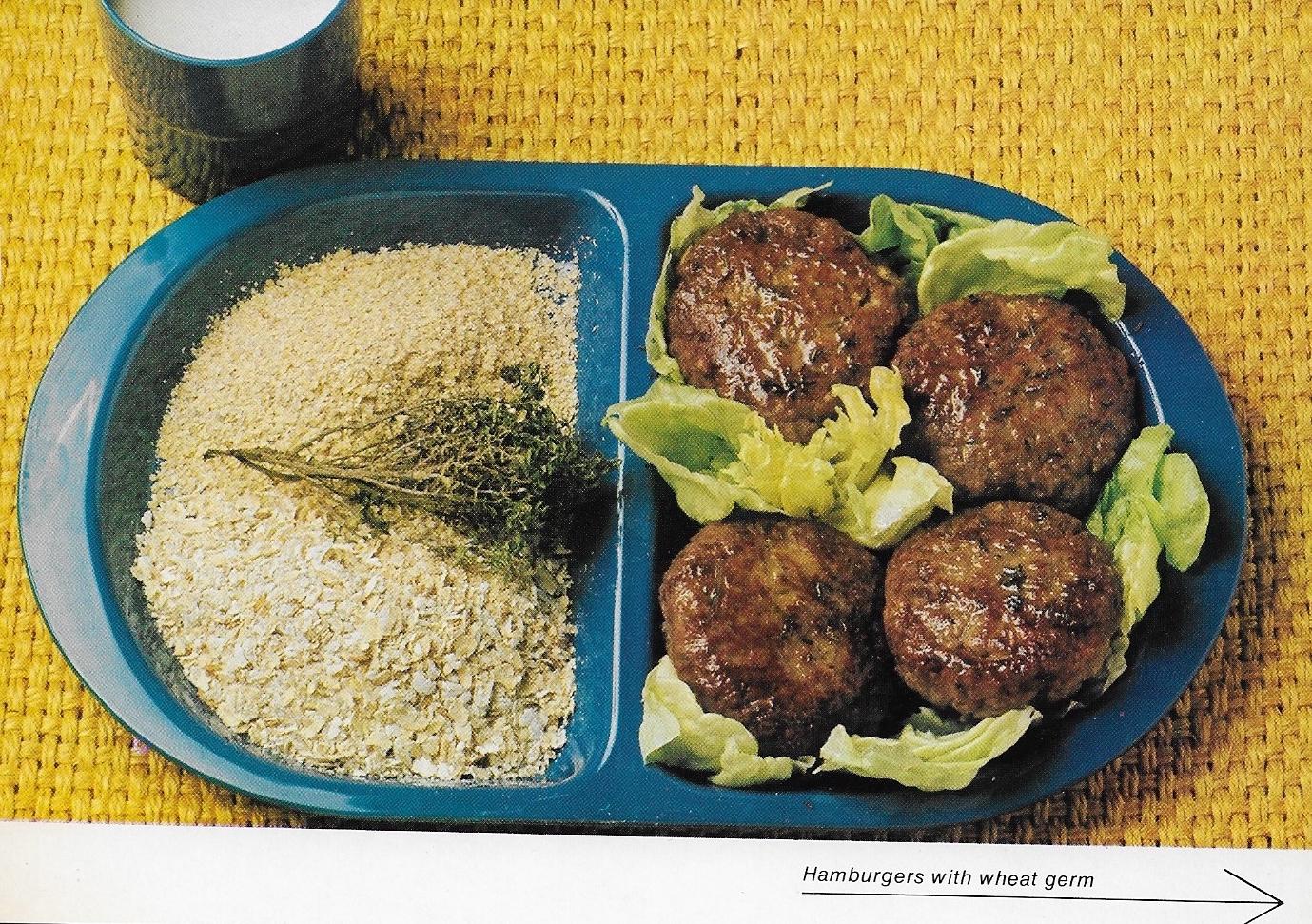
Soak the wheat germ in the milk for 15 to 20 minutes. Beat the egg in a bowl.
Mix the meat thoroughly with the oatmeal, egg, and wheat germ. Salt and pepper.
Shape into 8 meatballs or patties, and dust them with flour. Sprinkle them with thyme.
Fry them with the oil for 8 minutes on each side.
Do not keep the ground meat more than 3 hours, even in the refrigerator; an infant can then eat it safely. Toasted wheat germ is available in health-food stores and most supermarkets.
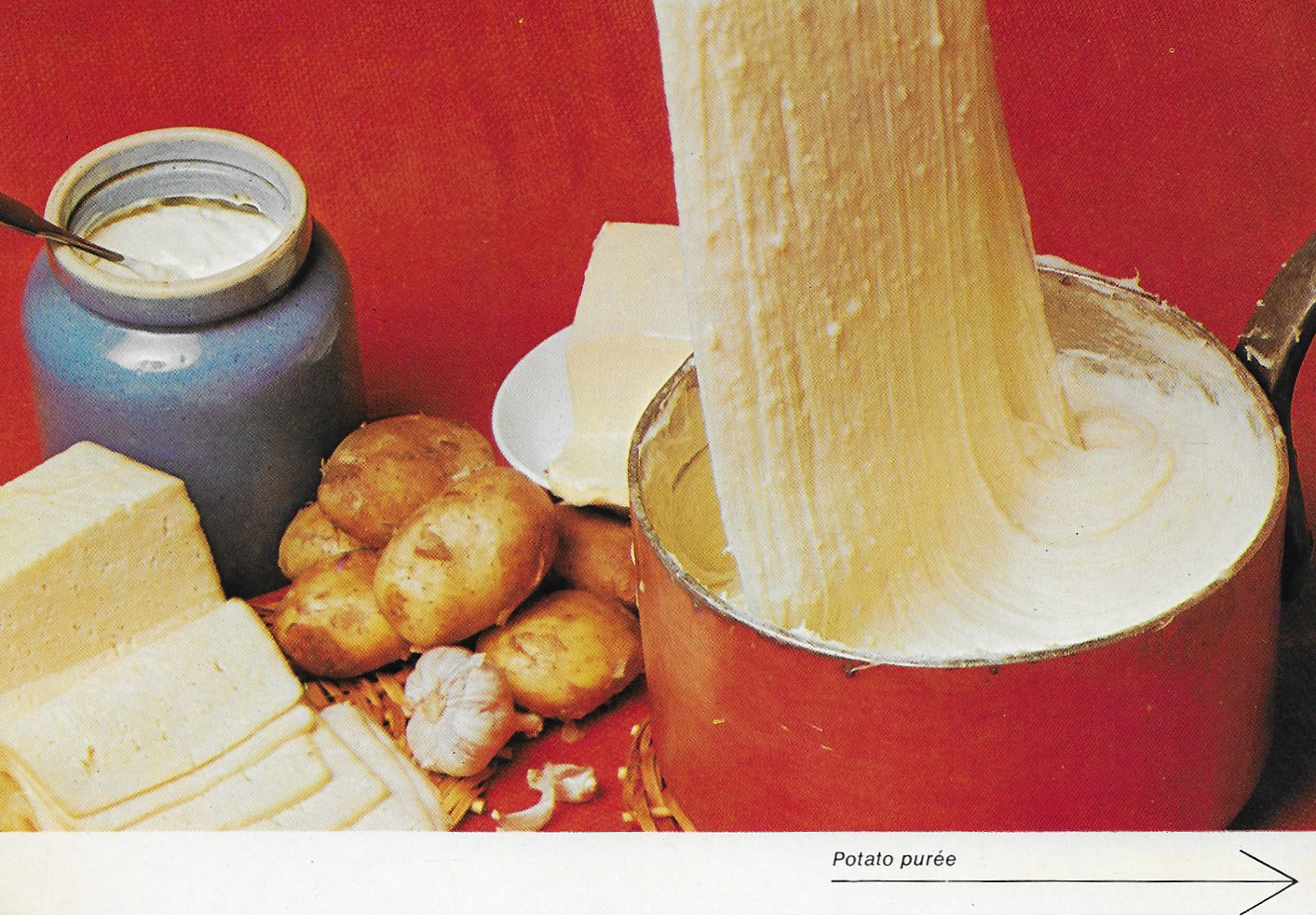
ingredients: 1 clove garlic 12 ounces unripened soft cheese (traditionally cantal) 1 pound potatoes 2 ½ Tablespoons butter 1 ¼ cups heavy cream pepper, salt
instructions:
Crush the garlic. Slice the cheese very thin, or shred it if you wish. But do not grate it.
Wash the potatoes carefully and boil them unpeeled in salt water for 30 minutes. Then peel and mash them immediately. Stir the purée over a low heat to dry it somewhat.
Mix in the butter, cream, garlic, salt and pepper.
Add the cheese continue to stir the purée. You will gradually obtain a homogenous threading mixture.
Serve immediately, since this purée cannot wait.
This distinctive purée will particularly enhance a roast beef dinner.
ingredients: 8 pitted prunes 1 teaspoon fresh yeast 1 cup milk ½ cup beet leaves 8 sprigs parsley 1 sprig (or ½ teaspoon dried) tarragon 4 sprigs (or 1 teaspoon dried) chervil 1 cup leftover meat ½ pound bacon 2 onions ⅓ cup flour 4 eggs salt, pepper 2 Tablespoons peanut oil, walnut oil, or safflower oil
instructions:
Soak the prunes in water or wine. Dissolve yeast in a tablespoon of warm milk. Was the beet leaves and the herbs.
Grind the meat, bacon, onions, beet leaves, and herbs.
Blend in the flour, eggs, salt, and pepper. Add the milk so as to obtain a thick, creamy liquid; add the yeast and prunes.
Heat the oil in a flameproof dish or Dutch oven over a low flame. When the oil is very hot, pour in the batter. Transfer the dish to a moderate oven and bake it for 30 minutes. Serve hot or cold.
In Auvergne, this meat cake is reheated by cutting it into slices and frying them in walnut oil, butter, or bacon fat.
ingredients: 2 pounds thinly sliced lean beef (from the rump or round) ¼ pound lean bacon strips 2 onions 2 shallots 2 cloves garlic 1 handful parsley 1 sprig thyme, or ½ teaspoon dried 1 bay leaf salt, pepper nutmeg 4 ounces fresh bacon fat 1 Tablespoon flour 2 cups dry white wine 1 calf’s foot 1 teaspoon agar-agar or Japanese Moss 1 cup beef bouillon
instructions:
Flatten the beef slices and season with salt and pepper.
Chop one onion, the shallots, garlic and parsley. Sprinkle in the finely chopped thyme and bay leaf. Add salt, pepper, and grated nutmeg to taste. Mix thoroughly.
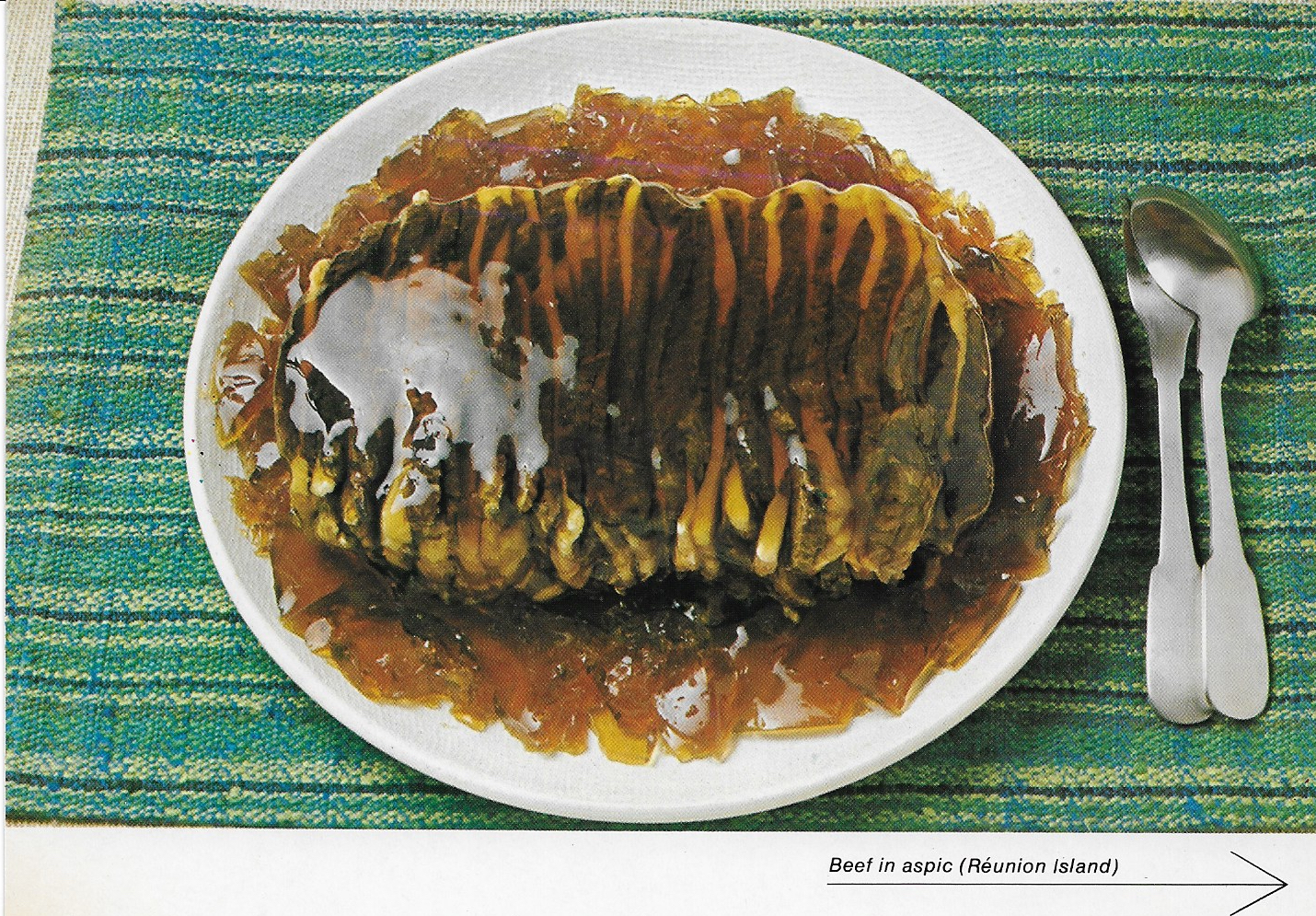
On each slice of beef place a slice of bacon and spread some of the herb mixture on it. Pile the seasoned slices into a “tower” and press as flat as possible. End with a slice of beef, then tie the entire pile together with string so it will not fall apart while cooking.
Mince the bacon fat and the remaining onion, sprinkle with flour, and add any remaining herb mixture there may be. Brown lightly in a Dutch oven. Add the wine, the calf’s foot, and the securely-tied beef slices. Cover and cook over low heat for 3 hours.
When done, remove the meat from the pot. Dissolve the agar-agar in the bouillon and add it to the liquid in the Dutch oven.
Place the meat into a mold and strain the liquid over it. Refrigerate. The sauce will jell. Unmold when ready to serve, and garnish with sprigs of parsley.
This dish is ideal for a meal served outdoors. As agar-agar and Japanese Moss are not readily obtainable, plan unflavored gelatine may be substituted, using a little less liquid than the instructions call for, in order to obtain a stiffer gelatine.
2 pounds small frying fish 3 Tablespoons flour 4 sprigs of parsley 2 cloves of garlic 3 Tablespoons olive oil 2 Tablespoons vinegar
instructions:
Clean and wash the fish; remove the heads. Pat dry. Roll into flour to coat completely.
Chop the garlic and parsley together.
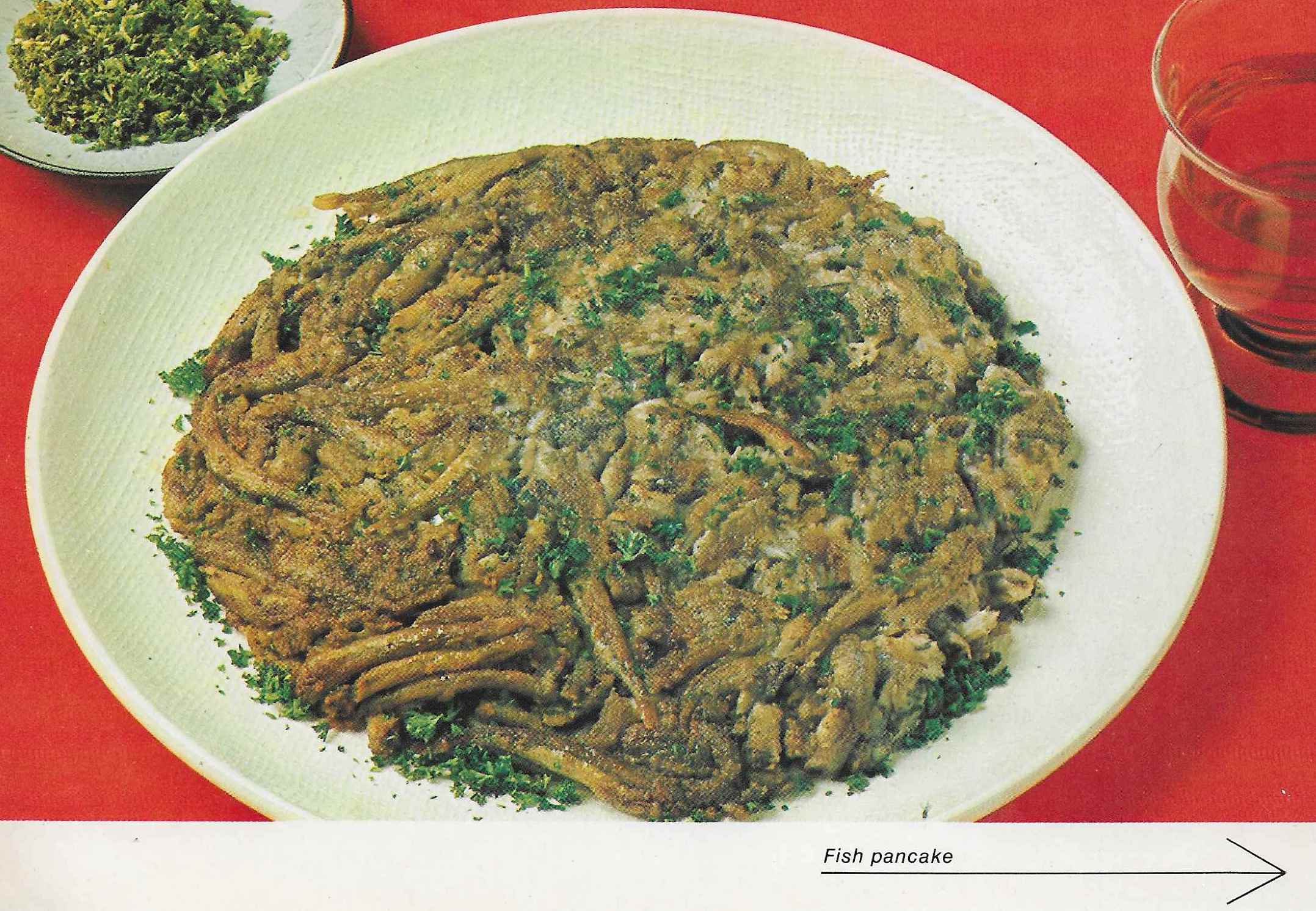
Heat the oil in a shallow saucepan. Add the fish. Pack them together so that they will stick to one another.
After 5 to 6 minutes, they will form a sort of pancake; turn it over. Cook for 2 to 3 minutes on the other side.
To serve: Sprinkle with the garlic and parsley mixture and cover with the boiling vinegar.
The sartadagnano, also called sartgnato in some small Mediterranean ports, can only be made with tiny fish whose bones are edible. To serve, slice like a cake.
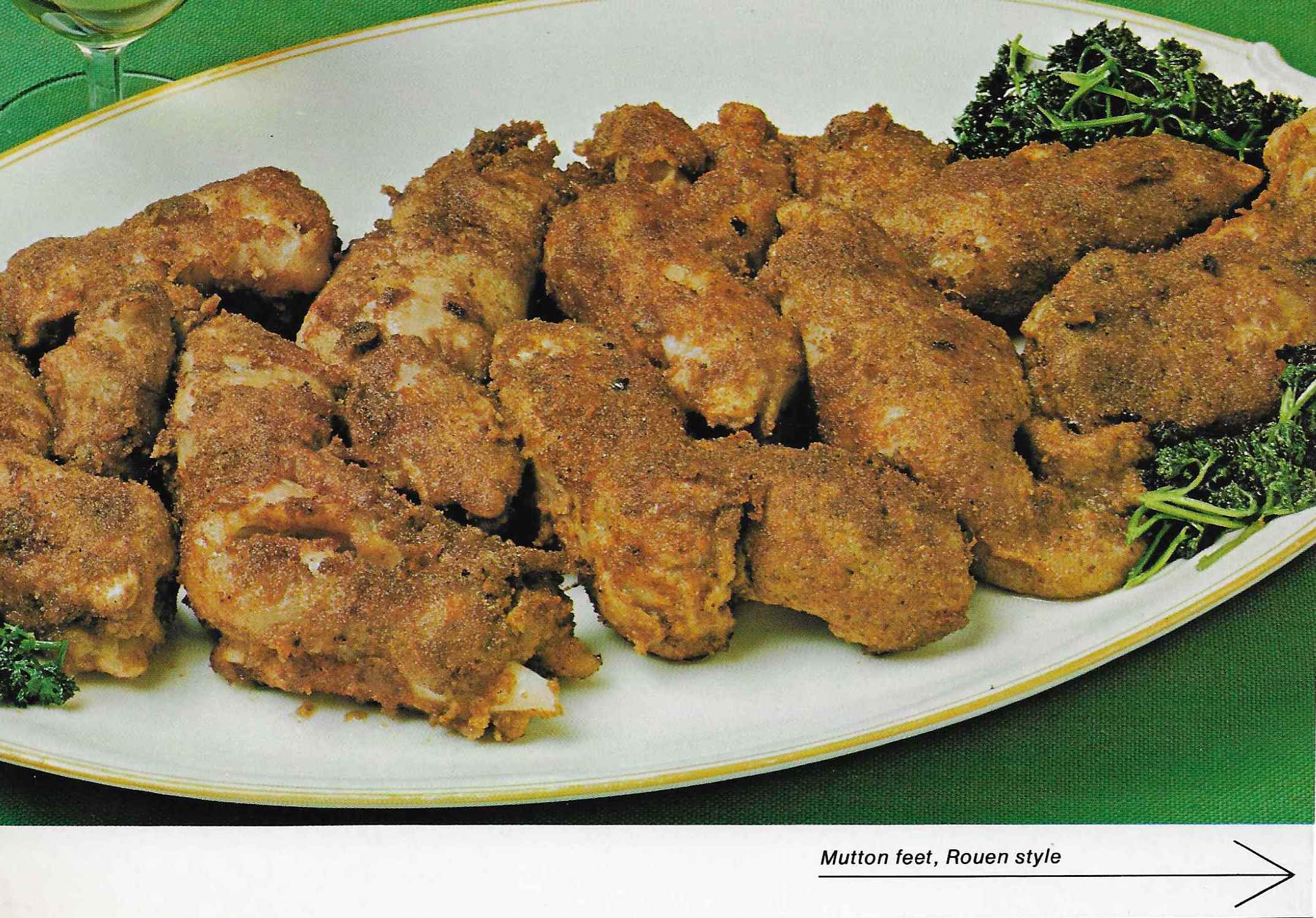
ingredients: 8 blanched mutton feet 2 onions 1 clove 3 Tablespoons graisse normandie (See recipe No. 1 Step No. 1) 1 fresh sprig or ½ teaspoon dried thyme 1 bay leaf salt, pepper 1 Tablespoon flour 3 Tablespoons vinegar 3 quarts of water 4 sprigs of parsley 1 Tablespoon butter 1 pork caul 4 ounces sausage meat 1 egg 4 Tablespoons dried breadcrumbs
Instructions:
Singe the feet that are already blanched. To blanch: Scrub the feet well. Rinse under cold running water. Place the feet in a saucepan. Add cold water to cover. Slowly bring the water to a boil. As soon as it begins to boil, remove the feet and immediately rinse under cold water. Remove any remaining hair, especially the small ball of wool situated in the inner portion of the foot, between the two hoofs.
Sauté the whole onion, stuck with the clove in the graisse normande. Add thyme and bay leave. Salt and pepper. Sprinkle with the flour. Stir. Brown lightly.
Sprinkle with vinegar and add the water. When the liquid boils, add the feet. Cook, covered, for 3 to 4 hours at a very slow boil. Add more water if necessary.
Chop the second onion and the parsley. Sauté in butter. Add the sausage meat.
Drain the feet. Bone, taking care not to break the flesh. Stuff each food with some of the mixture. Wrap in a piece of pork caul.
Beat the egg in a dish. Put the breadcrumbs in another dish. Dip the feet into the egg, then roll in the crumbs. Deep fry in hot fat.
Serve very hot.
This is a very popular dish from Rouen. To make the graisse normande, see recipe No. 1, step No. 1
Graisse Normande (Normandy Fat) Dice 2 parts beef kidney suet. Melt it in a large saucepan with 1 part lard over very low heat. When everything has melted completely, add cleaned and diced vegetables: 1 each onion, leek, carrot, celery stalk, sprig of parsley and 2 cloves of garlic. Salt and pepper. Simmer for 2 hours without browning. Strain through a very fine sieve.
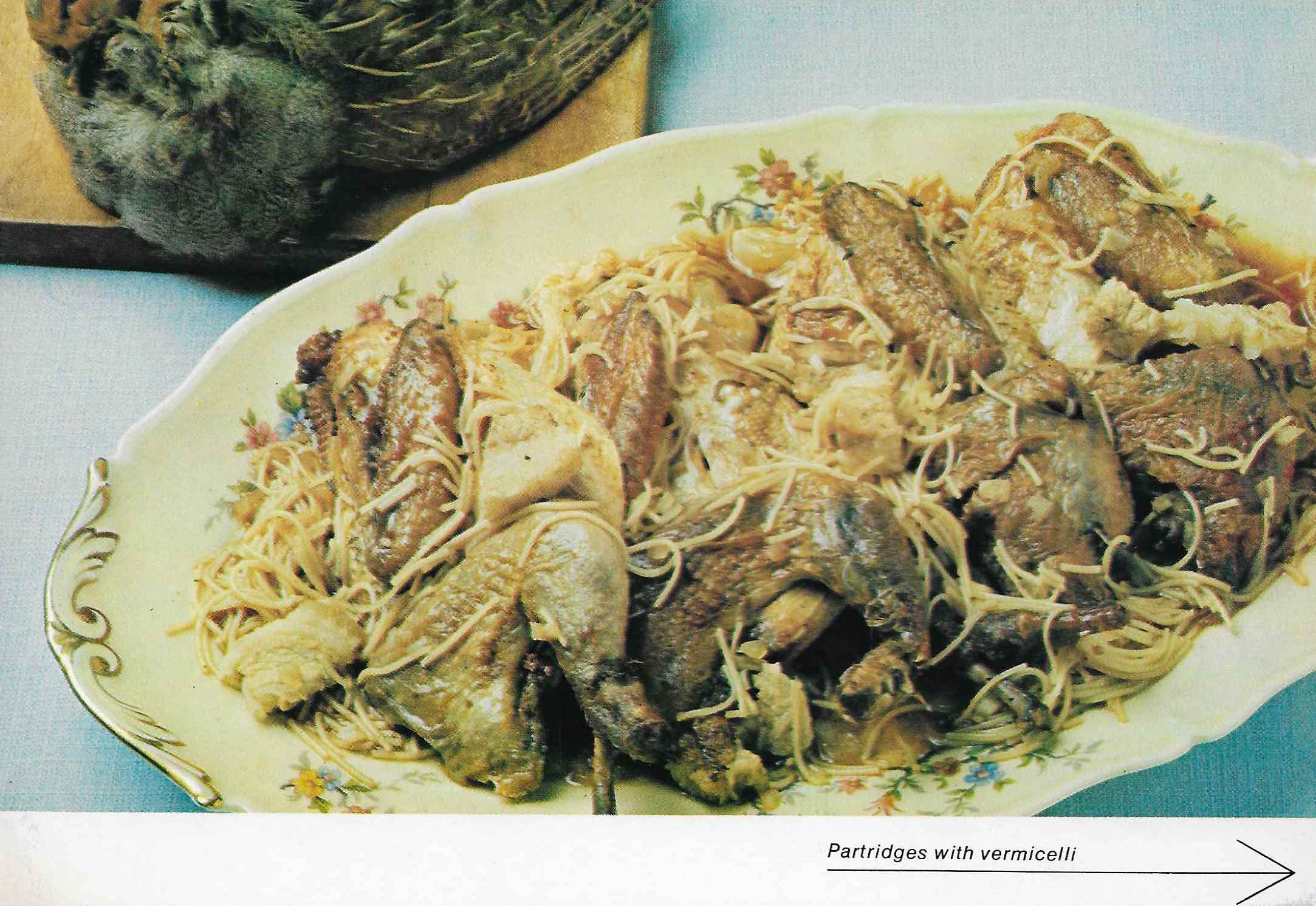
ingredients: 2 plump young partridges 4 Tablespoons butter ⅓ cup dry white wine salt and pepper 1 onion 10 small bacon cubes ½ cup shredded Swiss cheese ½ cup thin vermicelli 2 cups beef or chicken stock
instructions: 1. Clean the partridges and sauté them lightly in butter on all sides without allowing them to brown. 2. Add the wine. Salt and pepper. Cover and cook over low heat for 20 minutes. Remove from the heat and slit them in half. 3. Chop the onion. Scald the bacon cubes in boiling water. Add the onions and bacon cubes to the saucepan. Add the Swiss cheese and vermicelli. 4. Place the halved partridges in the saucepan, cover with the stock, and cook 20 minutes.
The Savoyards, who eat a good deal of pasta, are particularly fond of fidés, or thin vermicelli. It is best to use a small saucepan; otherwise you must increase the quantity of stock.
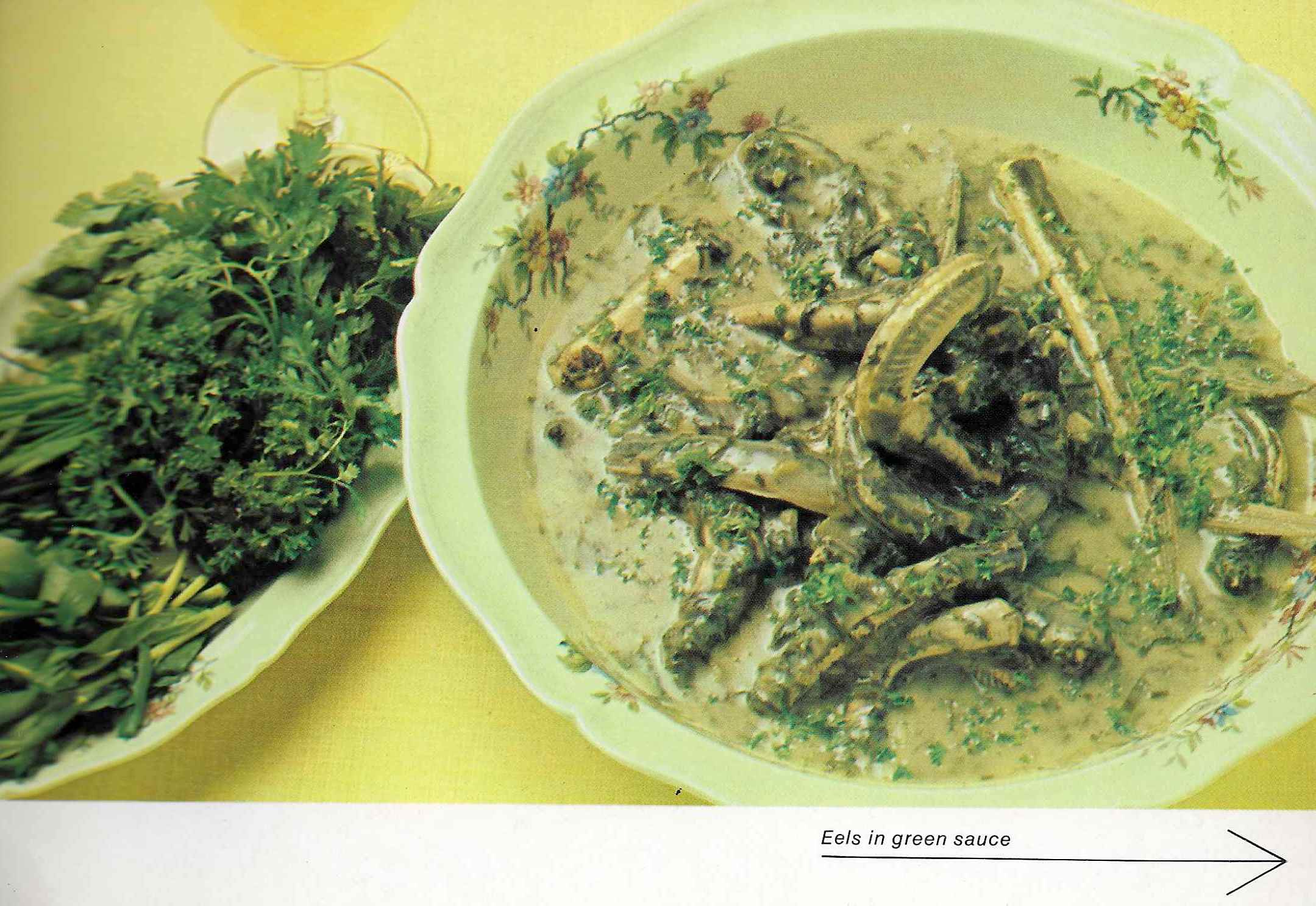
ingredients: 2 pounds of eels fresh herbs, as many of the following as possible (amounts are approximate): 5 ounces sorrel or watercress 2 ounces parsley 2 ounces chevril 1 sprig tarragon 1 sprig mint 1 sprig sage 1 handful spinach 2 ounces new leaves of white nettle 5 tablespoons butter 1 cup dry white wine salt, pepper 2 egg yolks 1 tablespoon heavy cream
instructions: 1. Clean and skin the eels; remove heads and tails. Cut into 2-inch lengths. 2. Wash and chop together all the herbs. Cook slowly in a large saucepan in butter. Add the eels and sauté 5 minutes. Add wine to cover the contents, salt and pepper to taste. Cook 15 minutes. 3. Remove from heat and thicken the sauce with a mixture of the egg yolks and cream. Add the lemon juice at the very last. Serve either hot or cold.
The more herbs you use, the better the dish will be. In Flandre, during some seasons, they use as many as fourteen varieties, including the young nettle leaves, which are traditional. The eels must be small.
Shufunotomo Co., Ltd., Japan, 1971 Published in the United States and Canada by BOBLEY PUBLISHING a division of Illustrated World Encyclopedia, Inc. Printed in Japan



 Vintage Recipe Cards