Category Archives: French

Canard Périgourdin (Duck, Périgord Style)

ingredients:
1 plump 4-pound duck (cleaned, singed, and washed)
7 Tablespoons butter
1 canned or fresh truffle
salt, pepper
30 pitted prunes
½ pound foie gras (goose liver mousse)
1 envelope unflavored gelatin

instructions:
1. Stuff the duck with a walnut-size piece of butter, the sliced truffle, salt and pepper. Sew up the openings.
2. Brush the duck with butter and season with salt and pepper. Place in a roasting pan and cook in a moderate oven for 75-90 minutes.
3. Poach the prunes in salt water for 15 minutes. Drain, and let cool.
4. Stuff fifteen of the prunes with the goose liver mousse, setting aside about 2 ounces of the mousse.
5. When the duck has cooled, cover it with the unstuffed prunes cut into halves. Stick them to the duck with the remaining mousse.
6. Prepare the gelatine as directed on the envelope. Coat the duck repeatedly with the gelatine, allowing it to “set” each time in order to obtain a thicker layer. Refrigerate.
7. Place the stuffed prunes around the duck, together with any leftover gelatine. Serve cold, with a green salad in season.


In the Périgord, the gelatine is flavored with the broth from one fresh truffle. The foie gras mousse is available in delicatessens and specialty shops.


©️ Shufunotomo Co., Ltd., Japan, 1971. Published in the United States and Canada by BOBLEY PUBLISHING, a division of Illustrated World Encyclopedia, Inc. Printed in Japan.
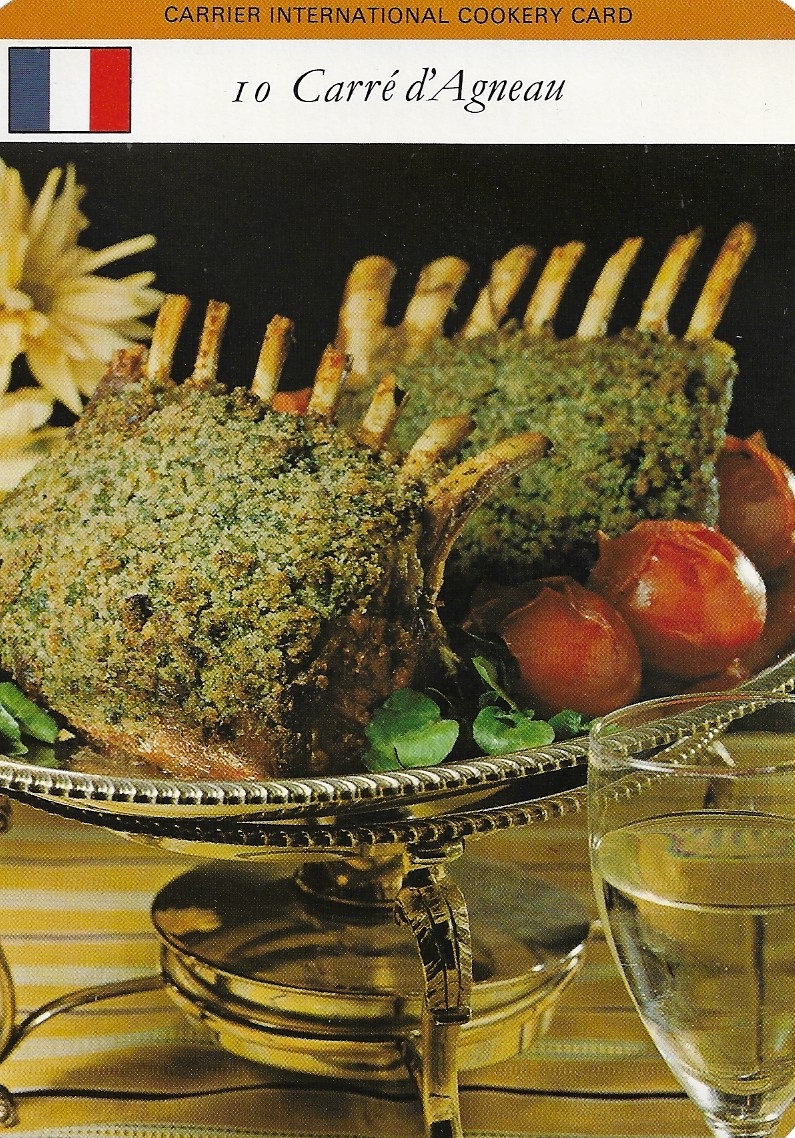
Carré D’Agneau (Rack of Lamb)

2 loins of baby lamb
Softened butter
Salt and freshly ground black pepper
4 ounces fresh breadcrumbs
4 tablespoons finely chopped parsley
½ level teaspoon dried thyme
½ level teaspoon dried marjoram
Grated ring of ½ lemon
Grilled whole tomatoes
Watercress

Spread loins of lamb with softened butter and season generously with salt and freshly ground black pepper; place in a roasting tin. Roast in moderately hot oven (400° – M5) for 15 minutes. Remove from the oven and cool.

Make a paste of breadcrumbs, chopped parsley, thyme, marjoram, lemon rind and softened butter, and coat sides of lamb thickly with this mixture.

Twenty minutes before serving, return loins of lamb to a moderately hot oven (400° – M5) and roast for 20 minutes.

Serve garnished with grilled whole tomatoes and watercress.

Serves 4-6


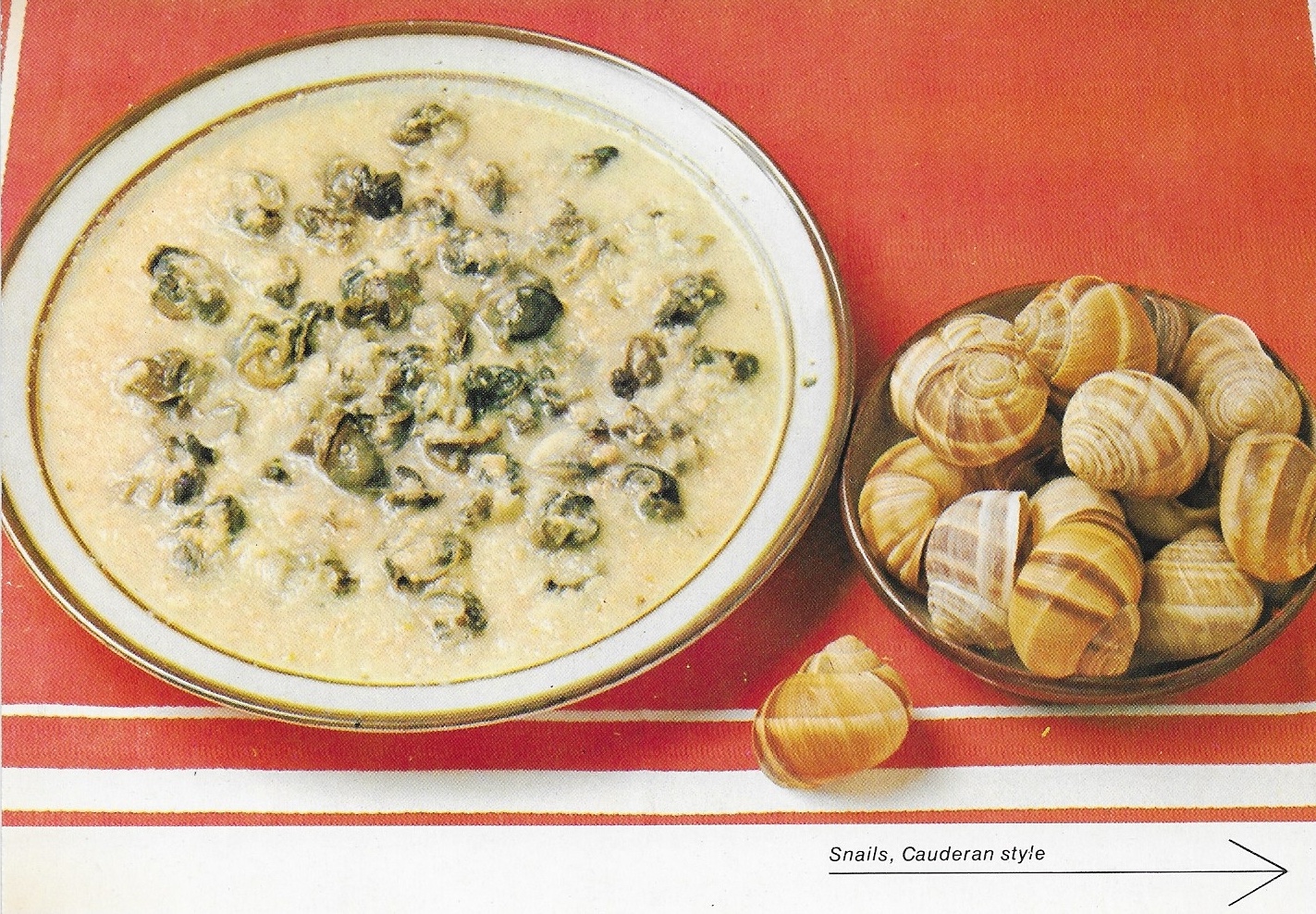
Escargots à la Caudéran (Snails, Cauderan Style)

Ingredients:
2 slices ham
2 cloves garlic
10 shallots
1 Tablespoon lard
½ cup crumbled stale bread
1 cup dry white wine
1 cup chicken bouillon
1 bay leaf
1 sprig, or ½ teaspoon dried thyme
salt, pepper
4 dozen canned snails (without shells)

Instructions:

  1. Chop the ham, garlic, and shallots, and sauté in melted lard in a frying pan. Do not brown.
  2. Add the crumbled bread to the frying pan. Pour in the wine and bouillon. Add the bay leaf, thyme, salt and pepper.
  3. Place the snails in the sauce, cover, and simmer for one hour. Stir occasionally.
  4. Serve hot.

Although live snails are used in France, they are not available in America. Canned snails are sold either in their shells, or plan, without shells.


©️ Shufunotomo Co., Ltd., Japan, 1971. Published in the United States and Canada by BOBLEY PUBLISHING, a division of Illustrated World Encyclopedia, Inc. Printed in Japan.
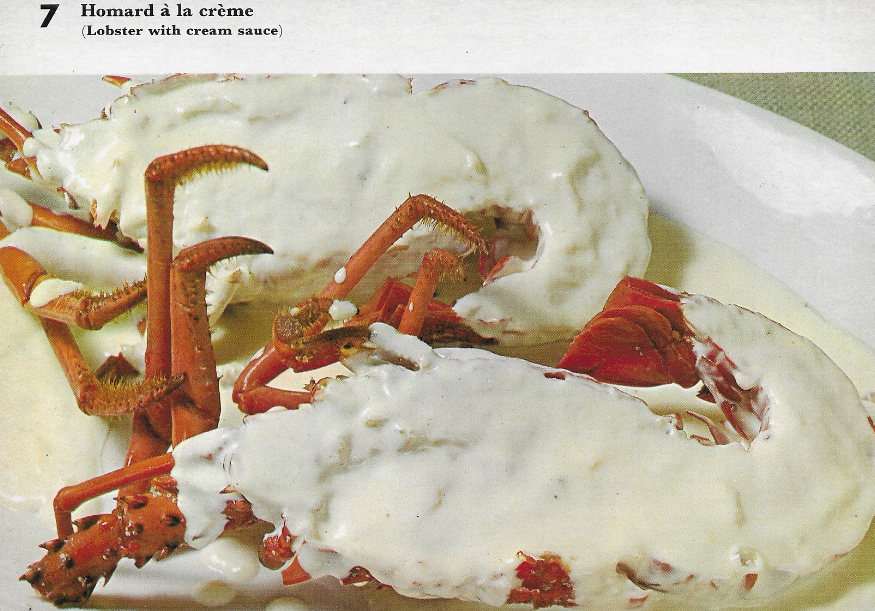
Homard à la Crème (Lobster with Cream Sauce)

Preparation time: 5 minutes
Cooking time: about 12 minutes
To serve: 2

You will need

1 freshly cooked lobster, about 1 lb
2 oz. butter
2 oz. button mushrooms, sliced
2 tablespoons brandy
2 tablespoons dry Madeira or sherry
salt and cayenne pepper
¼ pint (U.S. ⅝ cup) thick cream

Twist off the claws and with a large sharp knife split the lobster lengthwise down the back. Lay flat the two halves cut side uppermost and discard the stomach bag (from the head) and the black intestinal cord. Remote the tail and claw meat and cut into slant-wise slices.

Melt 1 oz. butter in a saucepan and over low heat cook the mushrooms for 1-2 minutes, remove and keep warm. Add the remaining butter and the lobster to the same pan, cover and heat gently for several minutes. Pour the brandy into a heated ladle, light with a match and pour flaming over the lobster. When the flames die, add Madeira or sherry, a little salt and one shake cayenne. Heat for a minute then add cream and cook gently, stirring frequently, until cream thickens. Return mushrooms to pan and spoon the mixture into lobster shells. Serve hot. Garnish with parsley, if liked.


Pissaladière (Pizza, Provençal Style)

Ingredients:
1 pound yeast dough
4 pounds onions, chopped fine
¾ to ½ cup olive oil
2 cloves of garlic
1 fresh sprig, or ½ teaspoon dried thyme
1 bay leaf
12 anchovies, well desalted
12 black olives
freshly ground black pepper

Instructions:

  1. Spread the dough with your hands on a greased baking sheet or pizza-pie pan. Heat the oil over low heat, add the onions and whole cloves of garlic. Salt lightly. Add the thyme and bay leaf. Cook for amout [sic] 20 minutes. Do not brown. Remove the garlic and spices.
  2. Pour the onion purée over the dough. Garnish with the anchovies and olives. Let rise in a warm place for 1 hour.
  3. Bake for 15 minutes in a hot oven. Sprinkle with freshly ground pepper.

The real pissaladière is made with yeast dough. You may be able to purchase some at your baker’s. If not, here is a recipe:
Prepare a leaven with ½ teaspoon of yeast, 1 cup flour and 1 teaspoon salt. Place the flour in a bowl, make a well and pour in the yeast dissolved in ¾ cup of warm salt water. Mix until bubbles form on the surface. Let the dough rise until at least double in bulk (from 1 to 3 hours). You may prepare the leaven the day before. Add 3½ cups flour, salt and about ½ cup warm water to make a firm, sticky dough. Knead until the dough becomes smooth and elastic (about 15 minutes). Form dough into a bowl, coat with flour, place in a bowl, cover with a cloth topped by a plate or with a plastic wrap and set in a warm place to rise until double its bulk, about 1 hour. Punch down and let rise again, until double its initial bulk. This should take about 30 minutes. The dough is now ready to use. You may also use dough made form pizza-pie mix.


©️ Shufunotomo Co., Ltd., Japan, 1971. Published in the United States and Canada by BOBLEY PUBLISHING, a division of Illustrated World Encyclopedia, Inc. Printed in Japan.

Rice à la Royale (French Rice Pudding)

¾ cup rice
2 cups milk
4 tablespoons sugar
Pinch of salt
Pears poached in syrup
Whipped cream

Custard
4 egg yolks
4 tablespoons sugar
4 tablespoons cornstarch
2 cups milk
Vanilla extract
1 tablespoon gelatine
6 tablespoons heavy cream
1-2 tablespoons Kirsch

Simmer rice in milk, sugar and salt until tender. Cool.

To make custard: combine egg yolks and sugar, and beat well. Add cornstarch and blend until smooth. Heat the milk slightly, with vanilla extract to taste, and pour on to egg mixture. Return mixture to saucepan and cook until thick and smooth, stirring constantly. Cool. Stir gelatine, dissolved in a little water, into custard, and when cool add cream and Kirsch. Leave to thicken slightly.

Stir in rice mixture and turn into a wetted mold. Refrigerate for several hours. Turn out and decorate with poached pears and whipped cream. Serve very cold. Serves 4 to 6.


Coeurs de Céleri en Salade (French Celery Appetiser)

2 heads celery
1 chicken stock cube
1 level tablespoon salt
½ pint well-flavored Vinaigrette sauce (see card 5 in this set)
½ level teaspoon paprika
Cayenne pepper
¼ pint double cream
4 hard-boiled eggs
4 tablespoons finely chopped parsley

Trim heads of celery, cutting off top third of branches and outside stalks; cut each head in half; put celery in a saucepan with trimmings, chicken stock cube and salt; cover with cold water and bring slowly to a boil. Simmer for 10 minutes; remove from heat. and leave in hot water for 5 minutes; drain and cool. Arrange celery in a flat serving dish; spoon over half of the Vinaigrette sauce and allow celery to marinate in this mixture for at least 1 hour.

Combine remaining Vinaigrette sauce with paprika, a pinch of cayenne pepper and the double cream; mix well. Separate yolks from whites of eggs, and rub each separately through a wire sieve.

To serve: place blanched celery hearts on a serving dish; cover each celery half with dressing; garnish on-third of each portion with sieved egg white, one-third with sieved egg yolk, and remaining third with finely chopped parsley. Serve immediately. Serves 4.


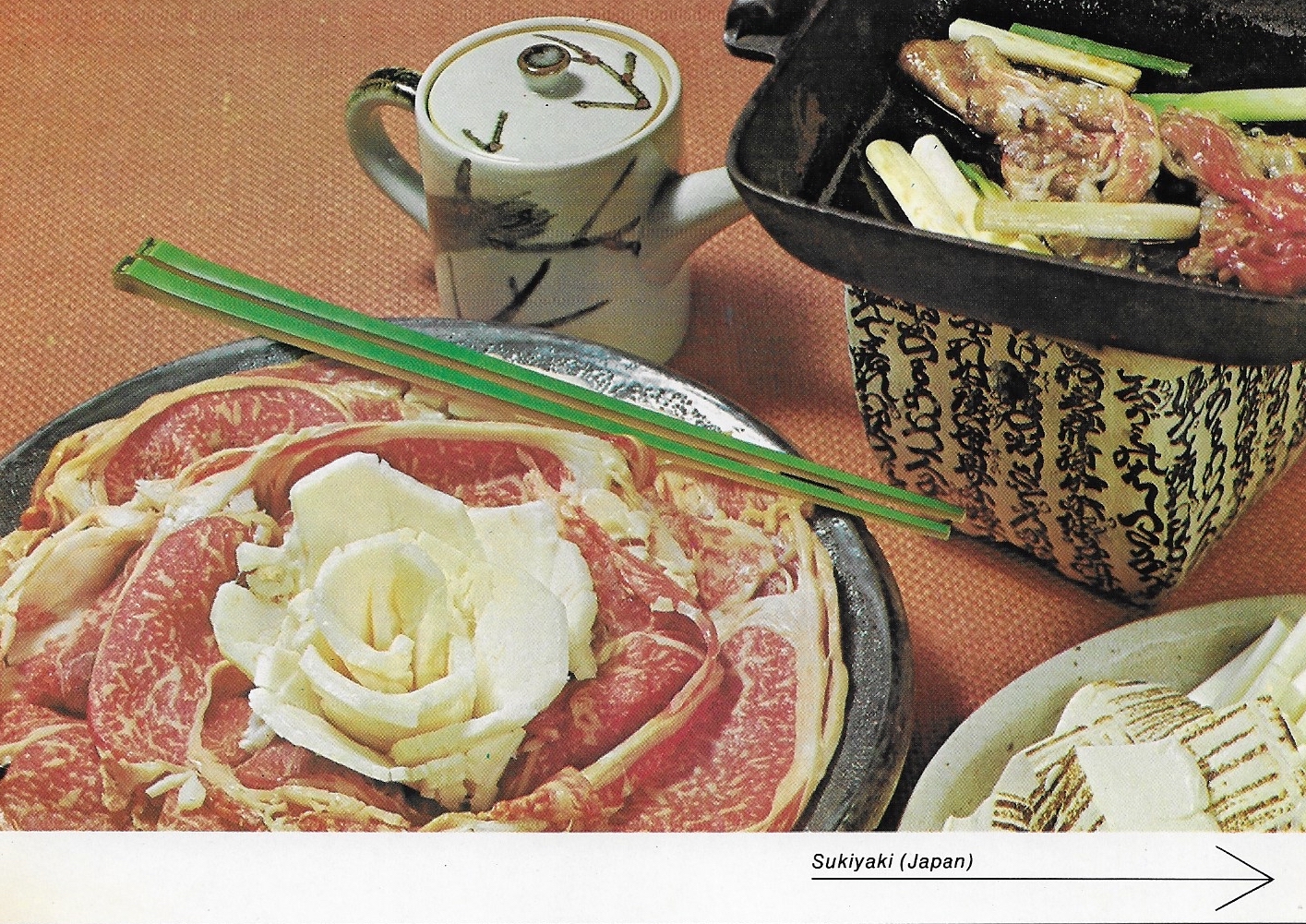
Sukiyaki

ingredients:

½ pound spinach
8 leeks, white parts only
2 onions
½ cup mushrooms
celery stalks
10 ounces bamboo shoots
1 pound 5 ounces slightly marbled beefsteak
3 Tablespoons peanut oil
4 eggs
For the sauce:
½ cup beef bouillon
½ cup soy sauce
4 teaspoons sake (Japanese rice wine)

instructions:

  1. Peel and wash all the vegetables. Chop the onions, mushrooms, celery, and bamboo shoots. Cut the meat into very thin slices.
  2. Prepare the sauce: Mix the bouillon, soy sauce, sake and sugar.
  3. At the table: Heat the oil in a pan. Add the onions and meat. Stir. Add the celery and mushrooms. Sprinkle with ⅓ of the sauce. Add the bamboo shoots and other vegetables, then another ⅓ of the sauce. Cook for 10 minutes and add the rest of the sauce. Cook for 5 more minutes and serve.
  4. Give each person a bowl containing a beaten egg yolk to be sued as a sauce to dip each morsel of meat or vegetable.

All preliminary steps of preparing the vegetables and sauce are done in the kitchen. The final cooking is done at the table in a chafing dish. In Japan, the frying pan is shallow and very large; the sukiyaki ingredients vary according to the season. Vermicelli is sometimes added.


©️ Shufunotomo Co., Ltd., Japan, 1971. Published in the United States and Canada by BOBLEY PUBLISHING, a division of Illustrated World Encyclopedia, Inc. Printed in Japan.

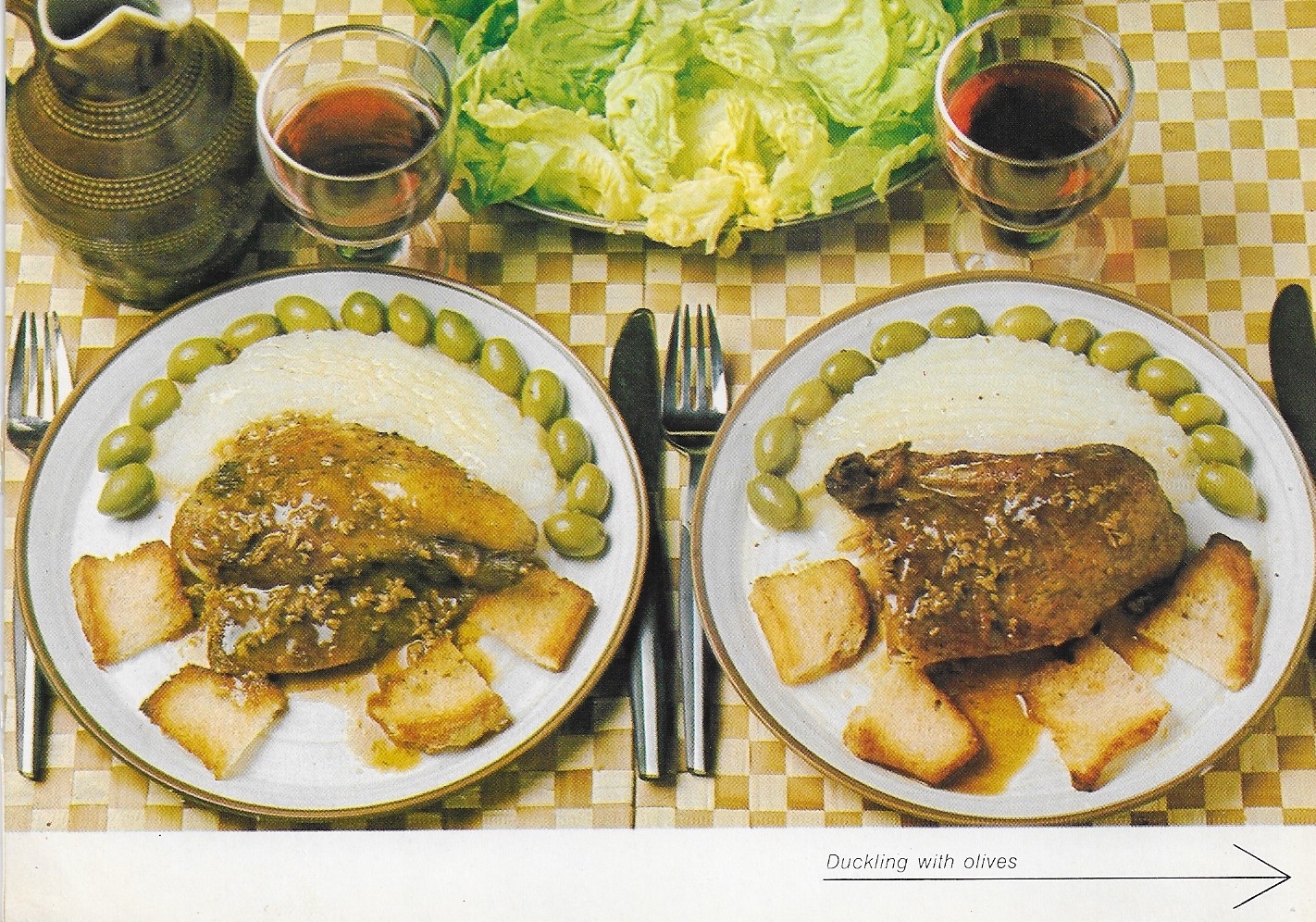
Caneton aux Olives (Duckling with Olives)

ingredients:

1 2-pound, 10-ounce duckling
1 Tablespoon butter
8 lean bacon slices
1 cup chicken broth
1 teaspoon thyme
½ a bay leaf
salt and pepper
½ cup green olives

instructions:

  1. Clean the duckling. Put aside the liver, heart, and gizzard.
  2. Saute the duckling in butter with the bacon in a round or oval casserole until golden brown on all sides.
  3. Empty the gizzard. Cut into thin slices. Slice the heart as well. Add both to the casserole, together with chicken broth, thyme, and bay leaf. Add salt and pepper. Cover the casserole and let simmer for 20 minutes.
  4. Meanwhile, pit the olives. Mash the liver with a fork. Mix all this in with the duckling and cook for another 15 minutes. Serve with fried bread croutons.

Mashed turnips will enhance this dish.


©️ Shufunotomo Co., Ltd., Japan, 1971. Published in the United States and Canada by BOBLEY PUBLISHING, a division of Illustrated World Encyclopedia, Inc. Printed in Japan.

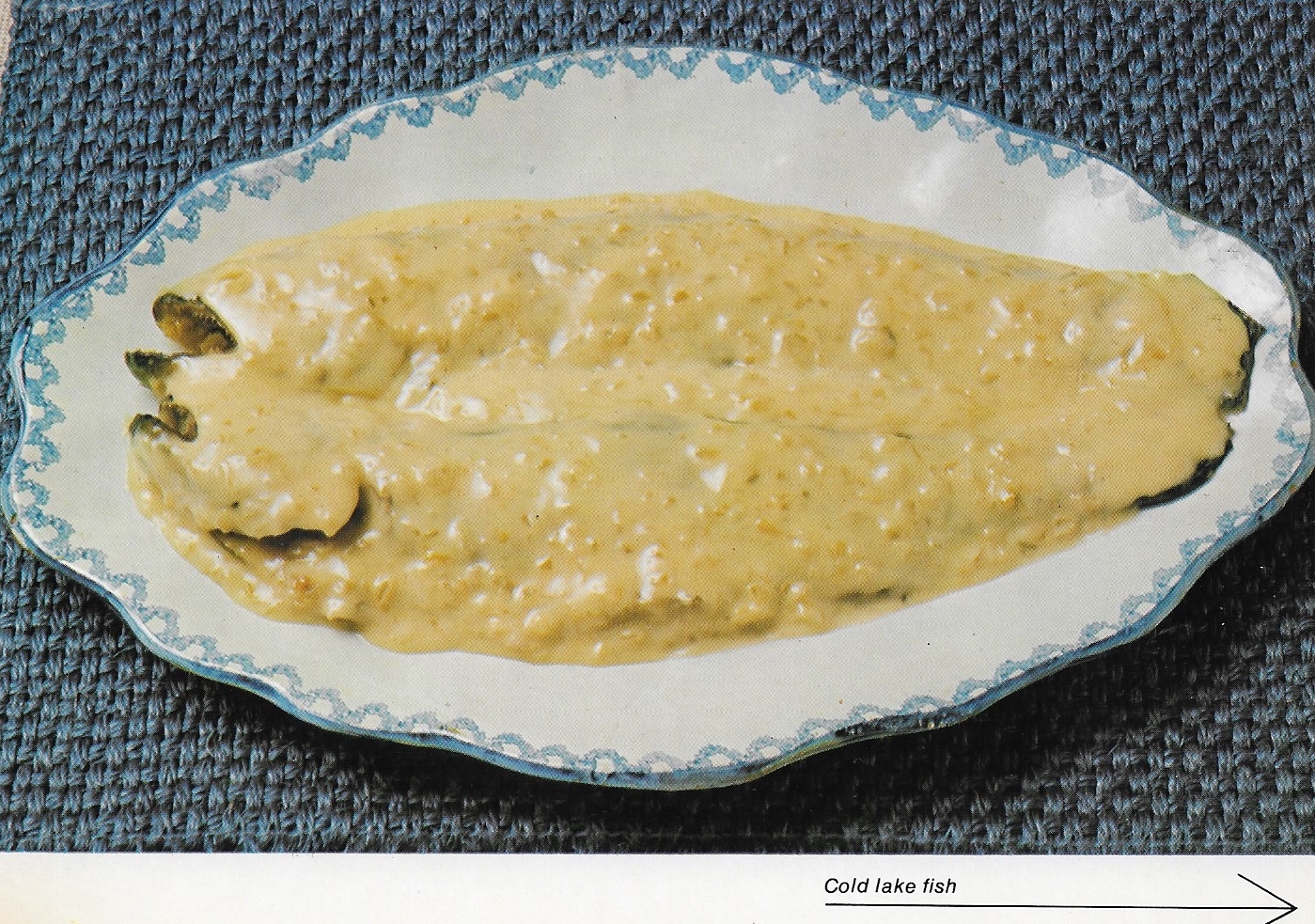
Féra du Léman (Cold Lake Fish)

ingredients:
1½ pounds féra, land-locked salmon, or several small fish
2 onions
2 shallots
2 cloves garlic
1 Tablespoon butter
1 cup broth
salt and pepper
1 teaspoon mustard
1 egg yolk
¾ cup vegetable oil
½ teaspoon vinegar

Instructions

  1. Clean and wash the fish.
  2. Finely chop the onions, shallots and garlic and sauté them slowly in butter until they begin to brown. Place the fish over them; add the broth, salt and pepper. Cook the fish over a high heat, 6 minutes on each side.
  3. Remove the fish to a serving platter and allow it to cool. reduce the cooking liquid over low heat.
  4. Meanwhile, prepare a mayonnaise: Mix the mustard and egg yolk in a bowl. Add the oil dry by drop, beating with a wooden spoon. Salt, pepper and add the vinegar. (You may make the mayonnaise in a mixer; place the egg and mustard in the small bowl of your mixer, set the speed to high and let it run 1 minute. Reduce the speed to medium and add the oil teaspoonful by teaspoonful, making sure that each teaspoonful is thoroughly blended. End with the vinegar and 1 tablespoon of boiling water.)
  5. When the cooking liquid has become very thick, cool and carefully fold in the mayonnaise.
  6. To serve, cover the cold fish with the sauce.

This little-known recipe from Savoie is an excellent dish that is easily adapted to any sort of fish. All the ingredients must be at room temperature and the utensils must be spotlessly clean if the mayonnaise is to succeed.


© Shufunotomo Co., Ltd., Japan, 1971 Published in the United States and Canada by BOBLEY PUBLISHING, a division of Illustrated World Encyclopedia, Inc. Printed in Japan.