Category Archives: British, Scottish, Irish

Steak and Kidney Pudding

1½-2 pounds steak
½ pound calf’s kidney
2 tablespoons flour
Salt and freshly ground black pepper
6 ounces freshly grated or packaged suet
12 ounces self-raising flour
Dripping
4 tablespoons finely chopped shallot or onion
¼ pint rich beef stock
2-4 tablespoons port wine (optional)

Cut steak and kidney into rather small pieces, and shake well in a bowl containing flour and ¼ level teaspoon each salt and freshly ground pepper, until all the pieces are well coated.

Combine finely grated suet with self-raising flour, adding pepper and salt, to taste, to make a light suet crust.

Grease a pudding basin with dripping, line it with the crust and put in the seasoned meat and finely chopped shallot or onion. Combine stock and port wine (if desired), and fill up the basin with this mixture to near the top, adding a little water if necessary. Put on the pastry lid, making sure the edges are well sealed to keep in the steam. Cover the whole pudding with a floured cloth and simmer or steam 3 to 4 hours. The crust should be rather damp. Serves 4 to 6.


Raspberry Bavarian Cream

1 box frozen raspberries (10 ounces)
Juice of 1 large lemon
1 tablespoon gelatine
4 tablespoons milk
4 tablespoons sugar (optional)
2 egg yolks
1 cup heavy cream
1 cup crushed ice
Raspberries
Kirsch

Defrost raspberries in a bowl with lemon juice.

Drain ⅔ cup of the raspberry juices into a saucepan (or if dry pack raspberries have been used, add 4 tablespoons to ⅔ water) and bring to a boil. Then pour the hot liquid into the container of an electric blender. Add gelatine and milk; cover and blend on high speed for 1 minute.

Remove the cover, add the raspberries and egg yolks. Then cover and blend at high speed for 5 seconds. Remove the cover, add cream and crushed ice, and keep blending until smooth. Pour into a mold and chill until set. Serve with raspberries moistened with 1 or 2 tablespoons Kirsch. Serves 4 to 6.


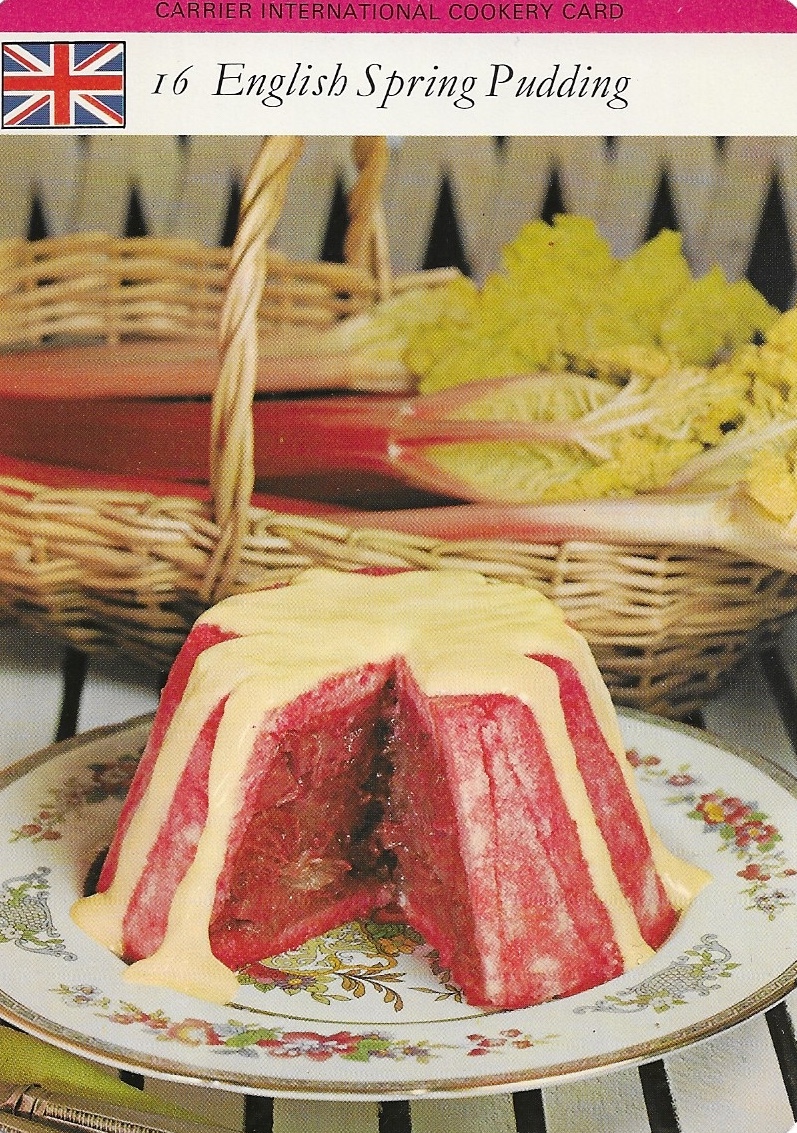
English Spring Pudding

2 pounds rhubarb
1 pound sugar
3 tablespoons lemon juice
3 tablespoons butter
Thin slices of white bread
Golden custard sauce or whipped cream

Wash and trim young rhubarb stalks, and cut into 1-inch segments. Combine rhubarb, sugar, lemon juice and butter in thick-bottomed saucepan; bring gently to a boil, stirring continuously; lower heat and simmer, stirring all the while, for about 5 minutes, or until rhubarb becomes soft, but still keeps its identity. Don’t let stalks disintegrate entirely; they must remain a trifle firm to be at their best. (Rhubarb varies enormously in flavour when cooked; so add a little more sugar (if too tart, a little more lemon juice if too sweet)

Lightly butter a soufflé dish; trim crusts from bread; cut each slice in half lengthwise and line sides of soufflé dish with bread. Cut enough slender triangles of bread to cover bottom of dish; and trim off standing bread slices at top edge of dish.

Fill dish with rhubarb mixture, reserving a little of the juices. Cut additional bread triangles to cover pudding. Chill in refrigerator overnight to firm pudding.

Just before serving, turn pudding out on a serving dish. POur over reserved rhubarb juices. Serve with a golden custard sauce or whipped cream. Serves 4 to 6.


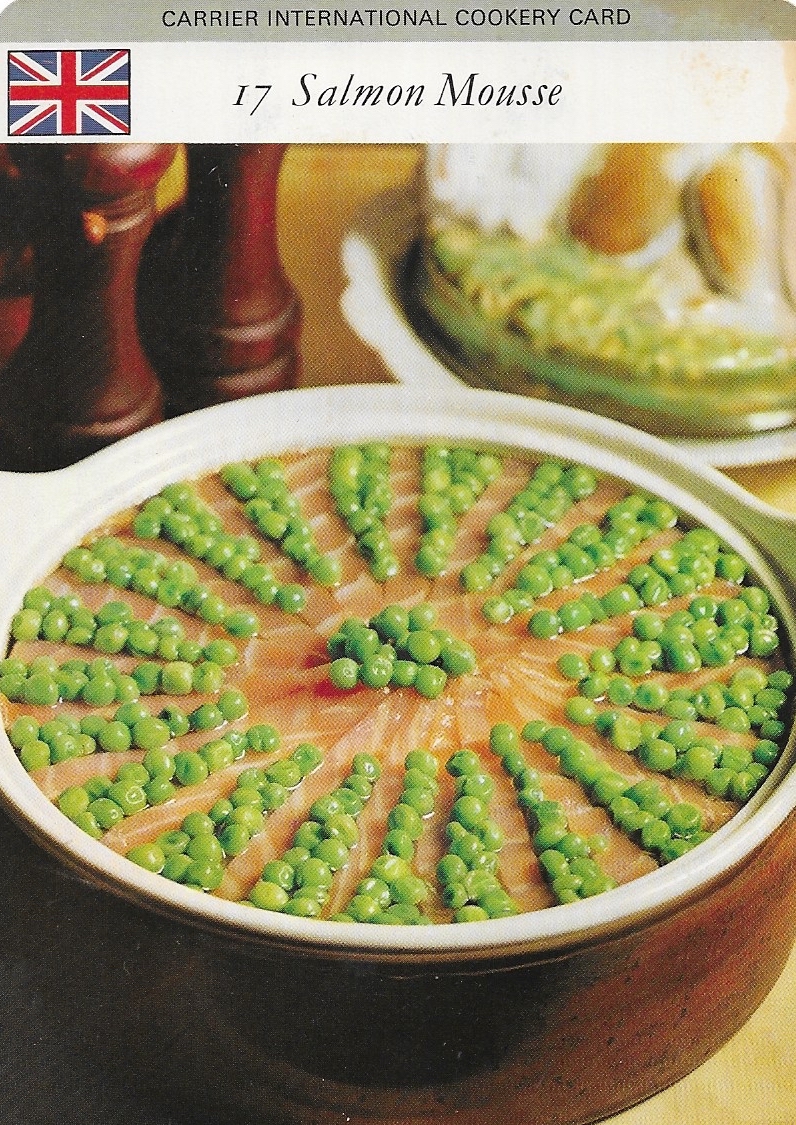
Salmon Mousse

¾ pound smoked salmon
Juice of ½ lemon
Salt and freshly ground black pepper
Freshly grated nutmeg
¼ pint single cream
Aspic jelly
½ pint double cream, whipped
2 egg whites, stiffly beaten
1 packet frozen peas, cooked

Chop ½ pound smoked salmon (reserving ¼ pound of the best pieces for garnish) and pound until smooth in a mortar with lemon juice and salt, freshly ground black pepper and nutmeg, to taste. Add single cream and pound until smooth again. Alternatively, combine chopped salmon with single cream, lemon juice, salt, freshly ground black pepper and nutmeg in an electric blender, and blend to a smooth purée.

When smooth, beat in 4 tablespoons liquid aspic jelly; then gently fold in the whipped double cream followed by the stiffly beaten egg whites. Pour mixture into a serving dish and chill.

When set, decorate with thin strips of smoked salmon and cooked peas (see picture). Pour over just enough liquid aspic to cover peas. Return to the refrigerator to set aspic. Serves 6 to 8.


Thomas Nelson & Sons Ltd., 36 Park Street, London W1 ©️ Robert Carrier 1968

Zuppa Inglese

4 eggs, separated
4 ounces sugar
4 ounces plain flour, sifted
Pinch of salt
Strega liqueur (or a mixture of cognac and rum)
½ pint double cream, whipped
¾ pint vanilla pastry cream (see below)
1 pint chocolate pastry cream (see below)
2 ounces chopped nuts
Coarsely grated orange peel
Chopped glacé cherries

Combine eggs and sugar in the top of a double saucepan and whisk over hot but not boiling water until thick and creamy. The mixture must not boil, or eggs will curdle. Remove from heat and allow to cool a little. Then lightly fold in sifted flour and salt.

Divide mixture into 3 sponge tins (7-inch, 6-inch, and 4-inch) and bake layers in a moderately hot oven (400° – M5) for 12 to 15 minutes. Cool and turn out of tins.

Cut each of the three sponge cakes into 2 layers and then cut 1 layer of each pair 1 inch smaller than the other. Sprinkle each layer with a little liqueur. Then sandwich sponge layers alternately with whipped cream, vanilla pastry cream, and chocolate pastry cream mixed with chopped nuts.

Assemble cake like an upturned “flowerpot”. Spread outside of cake with remaining chocolate pastry cream. Pipe with whipped cream and decorate with grated orange peel and glacé cherries.

Vanilla pastry cream: Cream 3 ounces sugar, 3 egg yolks and 11/2 ounces plan flour with a little milk in a bowl. Heat 3/4 pint milk infused with a vanilla pod in the top of a double saucepan. Stir gradually into the sugar and egg yolk mixture. Return mixture to top of double saucepan and cook over water, stirring constantly until mixture is thick and creamy. (Note: do not let mixture boil or eggs will curdle.) Cool.

Chocolate pastry cream: Cream 4 ounces sugar, 4 egg yolks and 2 ounces plain flour with a little milk in a bowl. Heat 1 pint milk with 3 ounces grated chocolate in the top of a double saucepan. Stir gradually into sugar and egg yolk mixture. Return mixture to top of double saucepan and cook over water, stirring constantly, until mixture is thick and creamy. (Do not let boil.) Allow to cool before using.


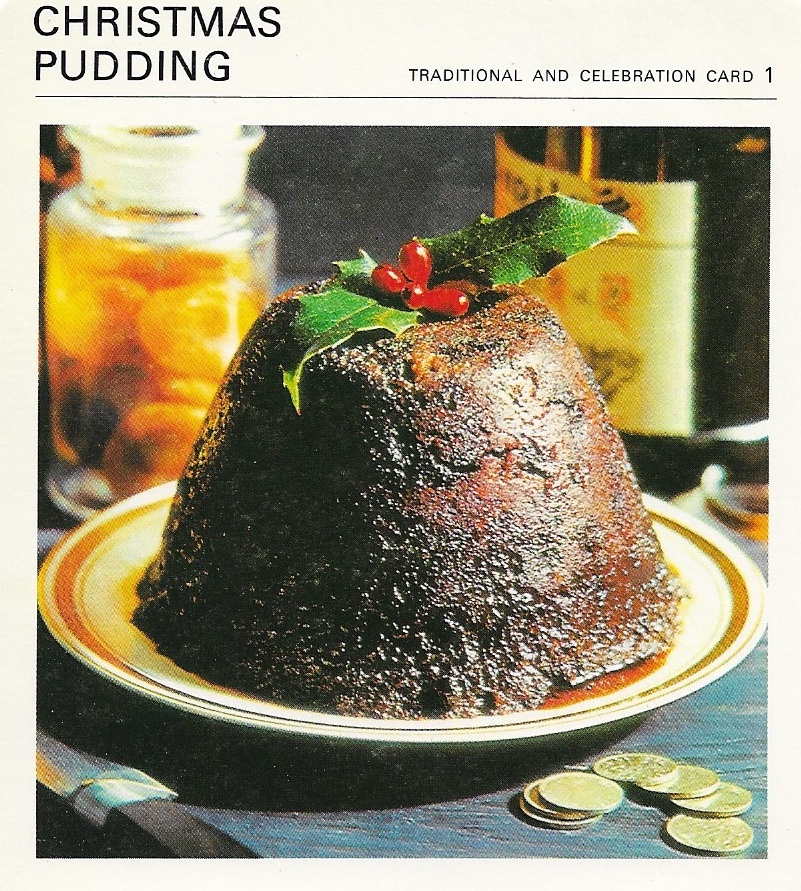
Christmas Pudding

Cooking time: 6-8 hours
Preparation time: 45 mins.
Main cooking utensils: 1 or 2 ovenproof bowls, foil or wax paper

For 12-16 servings:
1 cup all-purpose flour
1 cup fresh soft bread crumbs
1 teaspoon each mixed spice, cinnamon, and nutmeg
Scant cup shredded suet
½ cup brown sugar
1 dessert apple, grated
1 small carrot, grated
¾ cup chopped candied peel
2 eggs
Scant cup currants
1⅓ cups raisins
¾ cup seedless white raisins
Scant ½ cup chopped prunes or dried apricots
1 cup chopped, balanced almonds
Grated ring of ½ lemon
Juice of ½ lemon
Grated ring of ½ orange
1 tablespoon corn syrup or molasses
⅔ cup ale, beer, or milk

  1. Mix all ingredients together and leave overnight, then stir again wishing hard for good luck.
  2. Put into the greased bowl(s), cover with foil or wax paper. Alternatively cover the top with a flour and water paste (mix 2 cups flour to a paste with water).
  3. Steam or boil for time given, allowing longer time for one pudding. Remove wet covers as soon as pudding is cooked, then put on dry covered and re-steam for 2-3 hours on Christmas morning.

TO SERVE: With brandy butter made by creaming ½ cup butter, 1½ cups sifted confectioners’ sugar and 3 tablespoons brandy.

TO STORE: In a cool dry place.

Preparing fruit for Christmas cooking: If washing the fruit allow it to dry at room temperature for 48 hours.


PRINTED IN CANADA. © Copyright Paul Hamlyn Ltd 1967

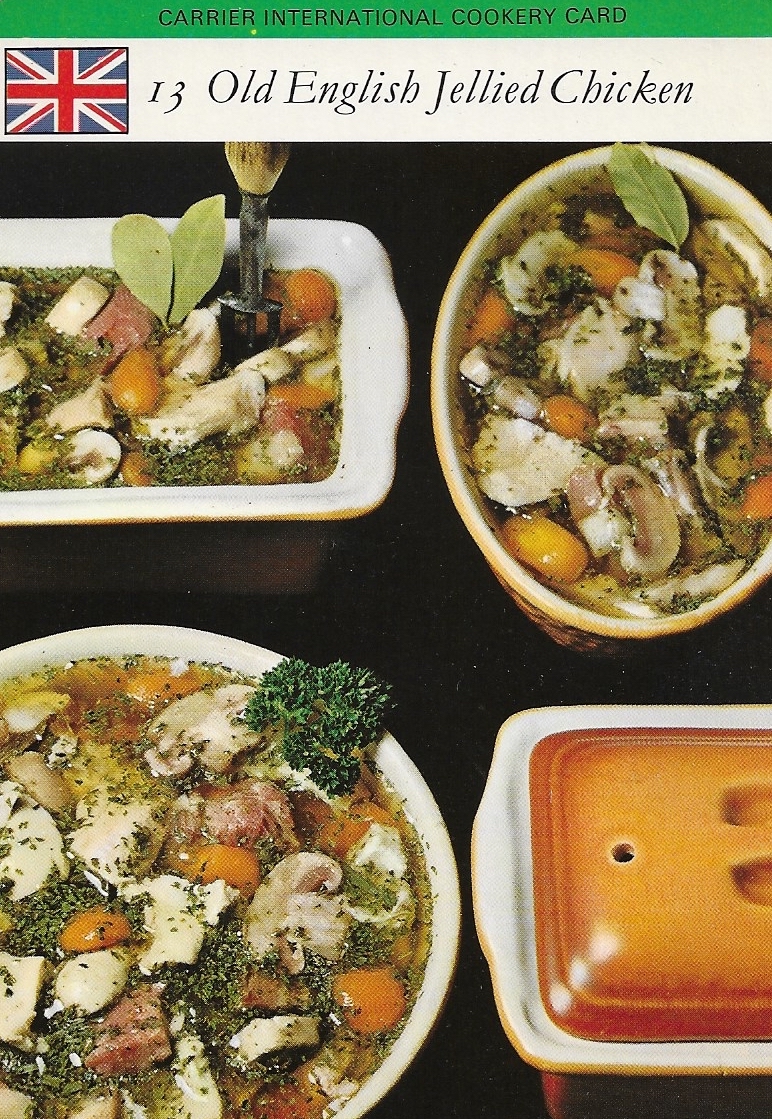
Old English Jellied Chicken

1 roasting chicken
½ pound gammon
1 Spanish onion, quartered
1 bay leaf
Chicken stock
12 button mushrooms, quartered
4 small carrots, thickly sliced
4 tablespoons butter
¼ pint dry white wine
1-2 tablespoons Madeira or brandy
½ ounce powdered gelatine
Salt and freshly ground black pepper
2 tablespoons chopped fresh herbs (parsley, chervil and tarragon)

Place chicken, gammon, quartered onion and bay leaf in a heatproof casserole just large enough to hold them. Moisten with about 1½ pints light chicken stock and simmer, covered until chicken and gammon are tender. Allow to cool in stock.

Cut chicken from bones and cut gammon into large dice. Place in an oval earthenware gratin dish or shallow terrine. Simmer quartered button mushrooms and sliced carrots in butter until tender. Drain and scatter over chicken and gammon.

Add ¼ pint dry white wine and 1 to 2 tablespoons Madeira or brandy. to the stock, and tri in gelatine which you have dissolved in a little water. Simmer for a moment, then strain. Correct seasoning; add chopped fresh herbs and pour over chicken and gammon pieces, adding more stock to cover. Allow to set. Serve gold from gratin dish or shallow terrine. A delicious first course, or light luncheon or supper dish.


Thomas Nelson & Sons Ltd, 36 Park Street, London W.1. © Robert Carrier 1968. Printed and manufactured in Holland

Veal, Ham and Tongue Pie

Hot water crust pastry
1½ pounds plain flour
2 level teaspoons salt
½ pound lard
½ pint water

Filling
¾ pound breast of veal
¾ pound gammon
¾ pound cooked tongue
½ Spanish onion, finely chopped
Thyme
Marjoram
Chopped fresh tarragon
Chopped fresh parsley
Salt and freshly ground black pepper
3 hard-boiled eggs

Garnish
Beaten egg
Aspic jelly

Hot water crust pastry: Sift flour and salt into a large mixing bowl. Melt the lard and water in a saucepan, and bring to a boil. Remove from heat. Add to the dry ingredients and mix quickly to a soft, pliable dough. Line a rectangular pie mould with two-thirds of the dough, pressing it well down into the corners.

Filling: Cut the veal, gammon and cooked tongue into cubes, and mix with finely chopped Spanish onion and generous amounts of thyme, marjoram and chopped fresh tarragon and parsley. Season to taste with salt and freshly ground black pepper. Half-fill the mould with the meat and herb mixture; arrange hard-boiled eggs on top and then fill mould with the remaining meat and herb mixture.

Roll out remaining pastry and cover the top of the pie, pressing edges well together. Trim edges and decorate with “leaves” cut from pastry trimmings. Brush with beaten egg; make three small holes in the pastry lid for the steam to escape, and bake in a fairly hot oven (425° – M6) for ½ hour. Then reduce heat to 375° – M4 and cooked for a further 1¼ hours. (If top becomes too brown, cover with a sheet of aluminium foil.) Allow pie to become quite cold. Remove rectangular pie mould and pour liquid aspic jelly (cool) through the holes in the pastry with the aid of a paper funnel. Leave pie overnight before cutting.


Thomas Nelson & Sons Ltd., 36 Park Street, London W.1. ©Robert Carrier 1968

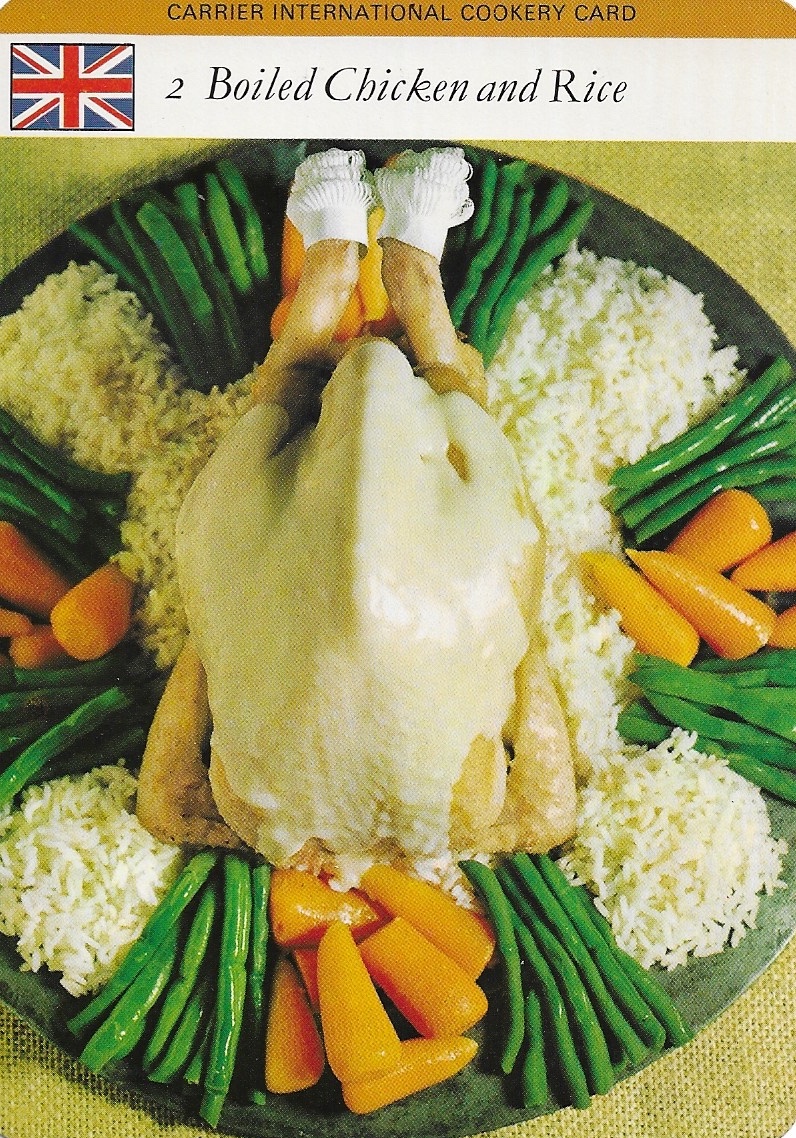
Boiled Chicken and Rice

1 fat chicken
1 Spanish onion, stuck with 2 cloves
2 large carrrots
Bouquet garni
2 stalks celery
1 glass dry white wine
1 quart white stock (chicken or veal, or both)
Salt and black peppercorns

Rice
1 tablespoon butter
1 Spanish onion, finely chopped
½ pound rice
½ pint strained chicken stock
Salt and freshly ground black pepper

Cream sauce
2 tablespoons flour
2 tablespoons butter
¼ pint strained chicken stock
¾ pint double cream
Salt and freshly ground black pepper
Freshly grated nutmeg

Garnish
Cooked carrots
Cooked green beans

Clean, singe and truss chicken; place in a casserole with an onion stuck with cloves; add carrots, bouquet garni and celery, and moisten with dry white wine and a good white stock. Season to taste with salt and a few peppercorns, and simmer gently for about 1 ½ hours, or until chicken is tender. Remove chicken and keep warm. Strain chicken stock and use for cooking rice and for cream sauce.

To prepare rice: Melt butter in a saucepan; add finely chopped onion and stir for a minute over heat until transparent. Stir in rice; add ½ pint strained chicken stock and 1 pint hot water; season to taste with salt and black pepper; simmer very gently, covered, for about 25 minutes, or until tender but not mushy.

Cream sauce: Make a white roux with flour and butter; add ¼ pint chicken stock and ¾ pint double cream, and bring slowly to a boil, stirring constantly. Simmer, stirring from time to time, until sauce is thick and smooth. Remove from heat. Season to taste with salt, black pepper, and nutmeg.

To serve: place boiled chicken in the centre of a large heated serving platter. Surround with colourful clusters of cooked whole carrots, green beans and rice. Pour a little cream sauce over chicken and serve with the rest separately. Serves 4 to 6.


Thomas Nelson & Sons Ltd, 36 Park Street, London W.1. ©Robert Carrier 1968

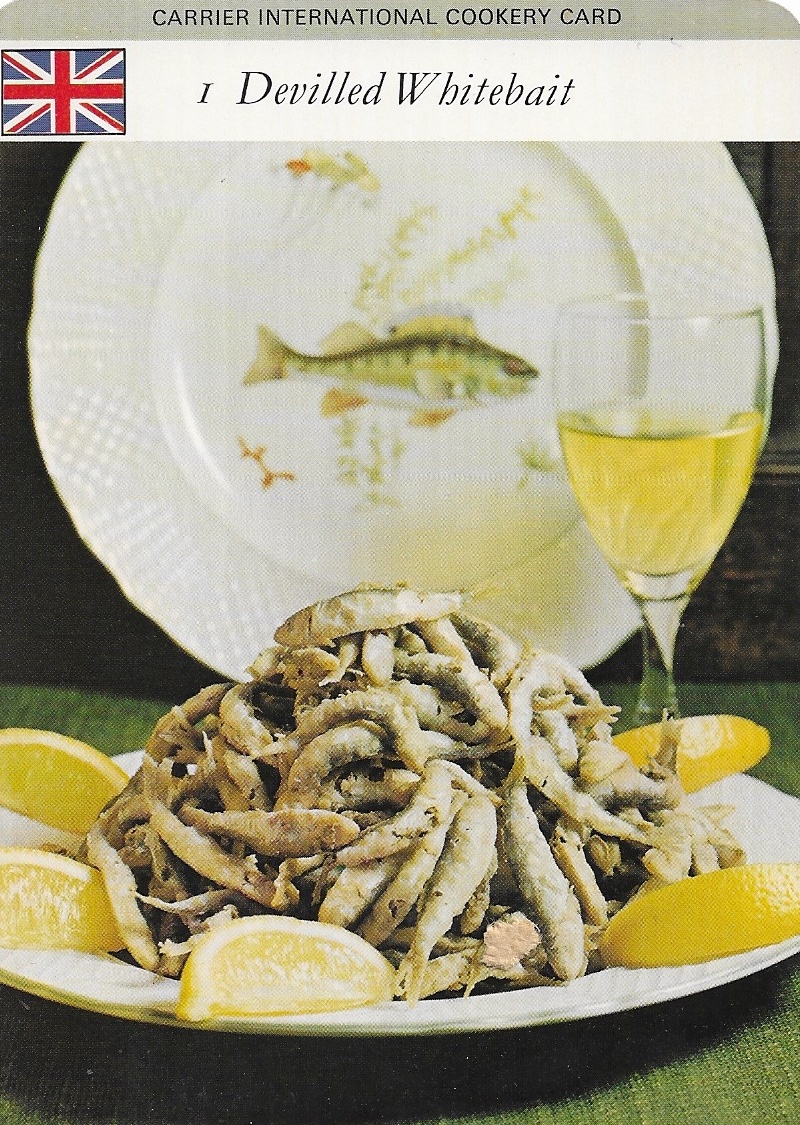
Devilled Whitebait

1 ½ pounds whitebait
Ice cubes
Flour
Salt and freshly ground black pepper
Lard, for frying
Cayenne pepper
Lemon wedges

Put whitebait to firm in a shallow bowl with ice cubes and a little water. Just before frying, spread fish on a clean tea cloth to dry. Place on paper liberally dusted with well-seasoned flour and dredge with more flour; place in a wire basket, a portion at a time, and shake off surplus flour. Then plunge the basket into very hot lard and fry quickly for 3 to 5 minutes, shaking basket continually to keep fish apart while cooking. Lift basket from fat and shake well before transferring fish to paper towels to drain. Place whitebait on a heated serving dish in a warm oven and repeat until all the whitebait are fried. Season with freshly ground black pepper and cayenne, and serve with lemon wedges. Serves 4 to 6.


Thomas Nelson & Sons Ltd., 36 Park Stree, London W1 © Robert Carrier, 1968